
 My Chart Patient Portal
 Language Services
 Medical Records
 News & Articles
 Charitable Giving
 Programs & Classes
April 2, 2026
AI in Healthcare at Southern New Hampshire Health: Advancing Safe, Patient-Centered Innovation
Artificial intelligence is becoming a bigger part of everyday life, and healthcare is no exception. At Southern New Hampshire Health, AI is helping improve how care is delivered while keeping safety, privacy, and the patient experience front and center. As more people hear about tools like ChatGPT, it’s natural to wonder how this technology fits into healthcare and what it means for patients.
At Southern New Hampshire Health, AI isn’t replacing doctors or personal connections. It’s being used to support them. From helping clinicians spend more time face-to-face with patients to improving accuracy behind the scenes, these tools are carefully reviewed before they’re ever put into use. Every step is taken to make sure new technology meets high standards for safety and quality.
The focus is simple: use smart, secure technology to make care safer, more efficient, and more personal for every patient in our community.
AI at work at Southern New Hampshire Health
But at Southern New Hampshire Health, doctors, clinicians, and staff are using AI to more accurately catalogue patient records and conversations and identify red flags in diagnostic tests.
 Jon Michael Vore, DO, Chief Medical Information Officer at Southern New Hampshire Health, says patients should know that the health system never uses any new software without extensive review and scrutiny. This has always been the case and continues to be as AI develops. However, Vore points out that, “There is a lot of new technology that we embrace because it increases safety. It might give us more meaningful time with patients or the opportunity to use advanced treatments. If there is something that can help us provide better care for our patients, we will see how we can integrate it.”
DAX Copilot: AI makes a good listener
Southern New Hampshire Health uses a program called DAX Copilot to help clinicians time focusing on their patients. The AI-powered listening program runs in the background to listen to the conversations between a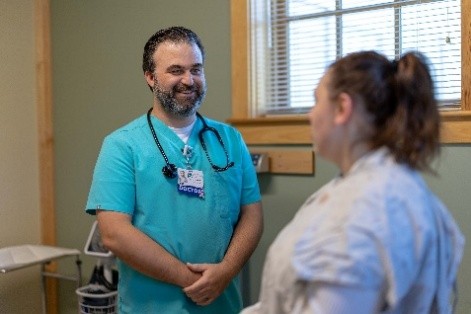 doctor, nurse practitioner, or physician assistant (PA), and the patient. It then creates structured, accurate notes that can reduce documentation time by up to 50%. Several studies have shown that this type of AI assistant can reduce the burden on clinicians. It also allows the healthcare provider to stay in the moment with the patient, rather than spend that time jotting notes in a health record. When the appointment is done, the document is ready for a clinician to review and sign.
GI Genius: AI can spot polyps in a colonoscopy
Colorectal cancer is the third most diagnosed cancer in both men and women in the United States. In the U.S., approximately 154,000 people are diagnosed with colorectal cancer a year, and approximately 53,000 people die from it.
Colonoscopies can prevent colorectal cancer or find it early, when treatment works best. That’s why every patient in the Southern New Hampshire Health System is encouraged to get screened for colon cancer, and why Southern NH Health became the first in the region to offer enhanced colonoscopies with an AI tool called GI Genius™. It is a module that uses artificial intelligence to help physicians detect potentially precancerous polyps.
“With GI Genius, we have an improved ability to see and remove potentially pre-cancerous polyps and provide even greater excellence in care to our patients,” said John V. Flannery, Jr., MD, a colorectal surgeon with Colon & 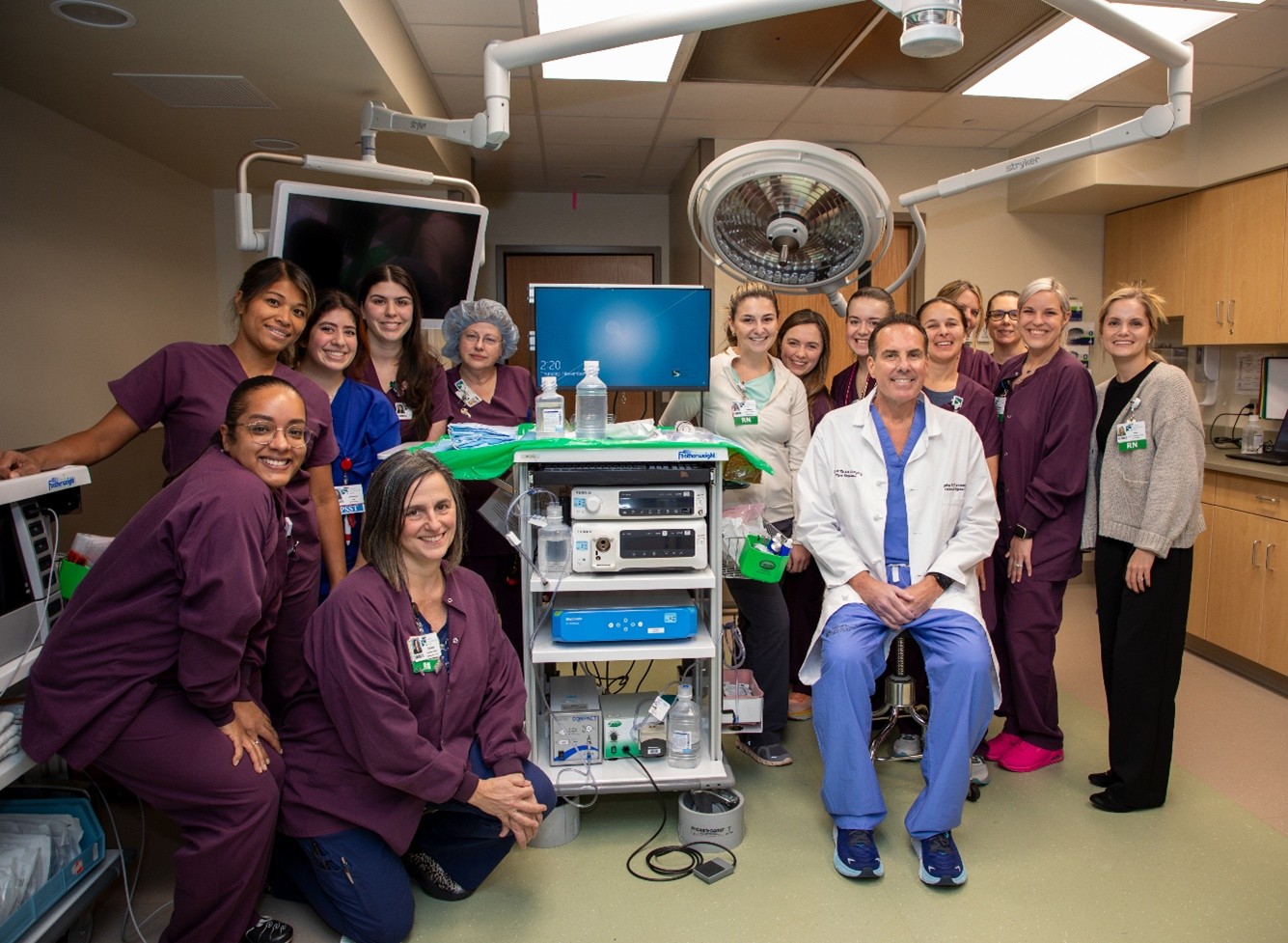 Rectal Surgery of New England. “The goal is to detect the potential for cancer as early as possible for the best outcome for our patients. We always look for leading-edge technology to accomplish this goal.”
Medtronic, the company that developed the tool, says it helps reduce the chance of missed polyps by up to 50%. It is not meant to replace doctors. It is meant to empower them.
AI can help maintain accuracy and efficiency
The reason nurses and other providers check and recheck patient names, dates of birth, and other unique information before a procedure or administering medication is to minimize the chance of errors. When information is confirmed, safety is achieved. Now, AI is helping add another layer of security to the protocols.
Though an app on a secure device owned by Southern NH Health, nurses and other providers can upload, check, and track real-time data to make sure no one in the system misses updates.
 When it comes to administering medication, there is a “safety check” feature that’s right there at the bedside with them. They use the device to scan the patient’s wristband and then the medication. If the medication is expired, it’s the wrong dose or wrong patient, the app flashes a warning. The system makes it so the provider doesn’t have to bring extra computer equipment into a cramped space to ensure accuracy.
Another feature of the app is for lines, like IVs, connected to patients. Providers document exactly when an IV was started or when a drain was emptied. The data is easily accessible in real-time and keeps tabs on the patient to prevent infections.
Innovation continues
Southern New Hampshire Health will continue to search for new AI products and technologies that advance our mission to deliver high-quality, expert, compassionate care right here to our region. Through advanced educational opportunities and study, clinicians and staff will move forward to keep the future as close to the present as possible.
Learn about surgical robots making a difference at Southern NH Health