
 My Chart Patient Portal
 Language Services
 Medical Records
 News & Articles
 Charitable Giving
 Programs & Classes
October 16, 2026
Gynecologic Cancer Basics: The Most Common Types, Signs, Symptoms, and Treatments
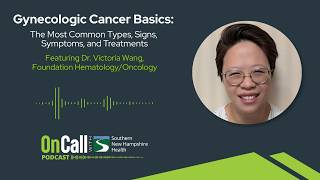
Each year, more than 100,000 women in the United States are diagnosed with gynecologic cancer. Yet many of the common symptoms can be mistaken for everyday health concerns.
In this episode of On Call with Southern New Hampshire Health, gynecologic oncologist, Dr. Victoria Wang, of Mass General Brigham and Foundation Oncology discusses uterine, ovarian, and cervical cancer, their symptoms, and when it's time to see your gynecologist.
Listen now to hear about the three most common types of gynecologic cancer.
Complete Transcript:
Keith Baldi: Welcome to On Call with Southern New Hampshire Health. I'm your host, Keith Baldi. On Call delivers the latest healthcare news and updates along with insights into the latest medical innovations and technologies. Southern New Hampshire Health is a nonprofit system serving the communities in Greater Nashua, New Hampshire, and Northern Massachusetts. The health system includes an 188-bed hospital, one of southern New Hampshire's most comprehensive teams of primary and specialty care providers, and five walk-in immediate care locations open seven days a week for urgent needs. Southern New Hampshire Health, expert care, close to home.
Thanks for joining us for this episode of On Call with Southern New Hampshire Health. Today we're focusing on gynecologic cancer, causes, signs, symptoms, and treatments. Every year in the US, more than 110,000 women are diagnosed with these types of cancers, and there's a lot for women, their families, and friends to know about. Dr. Victoria Wang, a gynecologic oncologist at Mass General Brigham, who sees patients here at Foundation Oncology, is with us to discuss this really important topic. Dr. Wang, thanks so much for joining us.
Dr. Victoria Wang: Thank you.
Keith Baldi: So, Doctor, before we launch into the questions about this and the discussion, I'd just like to let our listeners know a little bit about our guests. So, tell me a little bit about yourself. What got you into medicine and this specialty?
Dr. Victoria Wang: Oh, sure. I was very interested in bringing the science to people. I have studied biomedical engineering in undergraduate, and while it was very exciting to be on the cutting edge of all these new innovations, I was really struck by how far behind we were in actually getting that technology to people. especially people who may not have such easy access to bigger resources. So, I looked to medicine to be part of that implementation arm. And in finding the different fields of medicine, as you rotate through as a medical student, I was really struck by as gynecologists, we really take care of entire families because to take care of the women in our families is to take care of everyone, right? Women are the caretakers, they're mothers, and grandmothers, and aunts, and sisters. And it's really so important to focus on women's health. And the story I kept hearing over and over again from my oncologic patients was, oh, you know, the last couple of years I've been so focused on taking care of my husband, my child, my parent, et cetera. And I really haven't thought about these symptoms that have been going on for me and then they would show up at a point that cancer had spread quite far and was at quite an advanced stage. And it really struck me and I thought, this is who I want to be taking care of.
Keith Baldi: Well, that's amazing. And it's a great point because certainly, women play such a big role in everyone else's lives. We hear that a lot that oftentimes they neglect their own health. So that's wonderful. So, there are three types of gynecologic cancer that we're going to talk about today to learn about the differences. And they have very different symptoms, prevention, detection methods. So which cancers should women really be aware of and what can you say about the warning signs for each one?
Dr. Victoria Wang: Yes, I think it's important to consider that all of these cancers can be worked up and talked about with your regular gynecologist and are absolutely things women should be bringing to their routine appointments. The most common of the gynecologic cancers in women in the United States are uterine cancers, ovarian cancers, and cervical cancers.
Keith Baldi: Interesting. Okay, so let's start with one and then we'll move to the other. So uterine cancer. Let's start the discussion there. What changes in menstrual patterns should prompt someone to call their gynecologist? Are those pretty common things that you see?
Dr. Victoria Wang: Absolutely. So uterine cancers, we often can find at quite an early stage because women will have the symptom of bleeding. So having an awareness of your menstrual cycles of your periods is so important. And there are lots of reasons that your menstrual cycles might change that are not related to cancer. You know, there are hormonal changes. pregnancy, all kinds of other medical conditions. So not to say that all menstrual cycle changes are cancerous, but paying attention and noting that in the absence of any new medications or anything else going on, a change in the frequency and in how heavy your periods are a reason to bring that to your gynecologist's attention.
Keith Baldi: Absolutely. And that does happen to women of all ages. Do you see uterine, is there a category of age or is it all over the place?
Dr. Victoria Wang: It is more common in older folks, although we are, in the last decade, seeing a rise in uterine cancers in younger women, even as young as in their 30s and 40s. So definitely things to pay attention to.
Keith Baldi: Wow, yeah, absolutely. And are the symptoms different after menopause?
Dr. Victoria Wang: Yeah, absolutely. In post-menopause, really, any vaginal bleeding should be flagged immediately as a warning sign. There really shouldn't be any reason for bleeding postmenopausally, and we in the GYN world like to say postmenopausal bleeding is cancer until proven otherwise, because we don't have any of those other reasons, hormonal changes and medications, et cetera, to cause that.
Keith Baldi: That's interesting. Okay. So, what are some of the risk factors that are important to talk about when we talk about uterine cancer?
Dr. Victoria Wang: Absolutely. So part of the reason why we're seeing a rise in uterine cancer in the United States is that there are a lot of other medical conditions that are increasing here that increase your risk for uterine cancer. Things like obesity, diabetes, heart disease, all of these. Medical conditions also increase your risk for uterine cancer. And because we often can find this uterine cancer quite early, we're usually able to treat it quite effectively. But I like to say uterine cancer is often a canary in the coal mine, meaning it's a warning sign that other things in the health system might be going on. And it might be a good opportunity to think about, hey, how is my diabetes or heart disease or obesity affecting the other parts of my body?
Keith Baldi: Interesting. So, overall, and that's why you were saying things to talk about with your PCP or your gynecologist to take an overall picture.
Dr. Victoria Wang: Exactly.
Keith Baldi: And so that's always good advice to give people, right? I mean, if you feel something is going on, obviously you want to stay healthy, but if you feel something's going on, have that discussion.
Dr. Victoria Wang: Yes, absolutely.
Keith Baldi: All right, well, we'll move to ovarian cancer now. The second of the three that we wanted to talk about today. What routine testing can someone get for ovarian cancer?
Dr. Victoria Wang: Yeah, this is a question I get quite frequently because ovarian cancer, while it's less common than uterine cancer, often presents at more advanced stages and so can be much more dramatic to see someone in your life or to see someone in the media going through. Unfortunately, we don't have a routine preventative test right now for ovarian cancer. It is something we're working on. But because of how vague the symptoms are and because ovaries make cysts all the time that are normal and benign, we don't have a great way to differentiate early cancer.
Keith Baldi: That is something that a lot of women go through, have ovarian cysts, right? That's very common.
Dr. Victoria Wang: Yes, exactly.
Keith Baldi: And so the diagnostics are just, you test it. Tell me a little bit about that.
Dr. Victoria Wang: Yeah, we currently have ways that we can risk stratify ovarian cysts. There are features about them that we would see on ultrasound or imaging. that would tell us, hey, this looks more high risk or this looks more likely to be a benign cyst. And if you have cysts, your provider may get serial imaging, meaning image again in a couple of months, make sure things are kind of pointing in the right direction. And ultimately, the only way we can really diagnose what the cyst is made of is to surgically remove it. And so there have been studies where they look at, you know, what if we just scanned women routinely looked for cysts, and what they found was we would end up with a lot of what we call false positives, meaning we would end up doing a lot of surgery on women who ultimately have benign conditions. So, it's trying to find the balance between how do we really pick out the signal from the noise. Unfortunately, in ovarian cancer right now, the best we have is for women to pay attention to their symptoms. So, noticing new weight gain, bloating, increasing waist circumference, kind of vague symptoms of nausea and feeling uncomfortable. Those things are things that often don't point directly to the ovary, and so may take a couple of steps for us to figure out what exactly is going on. But again, things that are important to discuss with your provider.
Keith Baldi: And those are symptoms that can sometimes be overlooked, right? I mean, because what you're describing just sounds like that's part of everyday life for some people, right? Especially as you age.
Dr. Victoria Wang: Yeah, absolutely. And There can be so many things going on that those are easy symptoms that someone may brush off for quite some time or attribute to other things. medications, diet changes, maybe not sleeping great and having an extra cup of coffee, those things could cause you to feel bloated. Or really thinking about when those symptoms are persistent and maybe don't go away with an adjustment to those other factors that you think of as more commonly causing those symptoms.
Keith Baldi: Absolutely. So bloating is a symptom of this cancer, but could be, like you said, could be so many other things. When does it, just to put a point on this, because I think, obviously a lot of women do go through bloating from time to time. What is the difference? Is there a difference that you can say, this is something definitely to get checked out.
Dr. Victoria Wang: Yeah, I mean, if it's bloating that you feel, oh, after I have a bowel movement or after I kind of adjust my diet and increase my fiber, things seem to get better. Or after I take my antacid for my reflux, it gets better, then those are good reassuring signs. If it's bloating that is consistent throughout the day, it doesn't seem to change no matter if you ate or didn't eat or if you had a bowel movement or not, those are things that we would worry more about.
Keith Baldi: Sure. So if it's persistent, and over a period of time. Get it checked out. That's great advice. When it comes to ovarian cancer, are there specific family history triggers that you look at and say, oh, this is definitely something we should watch you more or is this just a factor of the way life goes in some ways.
Dr. Victoria Wang: This is a great question. And this has been in the news somewhat recently as well, that we're having success in prevention of ovarian cancer through identifying some of these genetic risk factors. So almost one in five ovarian cancer cases are genetically linked in some way. And it doesn't necessarily mean that you have a family history of ovarian cancer. Some of these genes are also related to breast cancer, pancreatic cancer, and so any family history of cancer, we certainly want to think about. It's a lot easier nowadays to get a genetic test and understand what your personal risk factors may be. There are some ongoing studies around, what if we remove your ovaries preventatively if we understand that your risk for ovarian cancer in your lifetime is quite high. And so again, the first step there is really talking to your provider about your family history of cancer, and they can determine if you are an appropriate candidate to get a genetic test. And then depending on the results of that genetic test, whether or not you're an appropriate candidate to preventatively get your ovaries out, always a good conversation to have. The other thing is, if you don't come from a large family or you don't have a lot of sisters and other female relatives, understanding what you can be doing routinely to screen for other types of cancers, breast cancer, colon cancer, have routine screening tests. Those things can also help us determine if you have an increased ovarian cancer risk.
Keith Baldi: Interesting. Does history of cysts make a difference or is this just specifically?
Dr. Victoria Wang: Yeah, a good question. So having a history of ovarian cyst at some point in your lifetime does not by itself increase your ovarian cancer risk, but having a history where we think perhaps you are having a lot of ovulatory events, meaning your ovaries are constantly being disrupted and the need to repair, that does increase your risk.
Keith Baldi: Interesting. Okay. And that's something that you can talk to your doctor about. And obviously seeing a doctor, you know, your gynecologist consistently is important to track these changes. or consistencies, I suppose, because that's more important, right, to look at history of what's happening.
Dr. Victoria Wang: So, what's happening over that long term? And something as simple as being on a birth control method that suppresses ovulation over a number of years can decrease your risk of cancer simply from preventing your ovary from having to repair itself after every ovulation.
Keith Baldi: Interesting. Okay, so that was a comprehensive look at that type of cancer. Now just look at cervical cancer. What are the roles of vaccines in cervical cancer? This is one certainly that we've learned a lot about over the last 20 years with HPV, right?
Dr. Victoria Wang: Yes, absolutely. I'll put an asterisk here and say, cervical cancer being the third most common of the gynecologic cancers, but HPV related cancers also encapsulate vaginal and vulvar cancers as well. We just don't know as much about them because those are more rare. But yes, cervical cancer is really the only cancer we have a vaccine program for, which is amazing to have a cancer vaccine out and available. The HPV vaccine is available as young as age 9 and available up until age 45 nowadays, although we know that getting it younger is more effective. and is preventative against the vast majority of cervical cancer cases. We can see in places like Australia that have mandatory vaccination programs, their rates of cervical cancer have dramatically decreased and they're projecting almost zero cervical cancer cases in the next 5 to 10 years because of that.
Keith Baldi: Wow, and that's, I know obviously we talked right at the outset of about 110,000 women and they're not obviously all cervical cancer because, you know, there are multiple types, but to talk about tens of thousands of women potentially who could be cancer free. That's a pretty remarkable thing. So certainly, your guidance is to get that vaccine in the schedule as you're a youngster.
`Dr. Victoria Wang: Yeah, and boys can get it too.
Keith Baldi: Right, because that's right. That can, and I know that that's discussion a lot of people have with their pediatricians, their parents, and with young children. So that's a great way to prevent. What are some routine tests for cervical cancer though, because not everyone gets that vaccine or there are obviously a lot of women who weren't, it wasn't available.
Dr. Victoria Wang: Exactly. Yes. The majority of adult women in the United States didn't come up in a time when the vaccine was available. It's true. Our pap smear screening program, the entire point of all those pap smears and pesky appointments that you go to is to detect early, what we call pre-cancerous changes of the cervix. The pap smear is generally a two-component test. So, one component is looking at the actual cells of the cervix to see if there are any abnormalities under the microscope, and the other component is to test for active HPV infection. Those two results together give us a sense of their patient's risk of developing a pre-cancer or cancer in the next three to five years. And that's how the recommendations from your pap smears come about. So, some people get a pap smear, and they'll get a message that says, great, we'll not need to do another pap smear for a few years. Some people get a pap smear, and they say, actually, we need you to come on back, and we need to take a closer look and potentially take a biopsy. This entire program is basically operating under the assumption that a lot of these HPV infection related cancers are relatively slow moving. It's not something that's going to happen overnight or even in a year. These tend to happen over the course of years and years of persistent active HPV infection. And so, we hope that we can catch these during that period of time before the cells have transformed into cancer.
Keith Baldi: Wow. So between the vaccines and that, you know, the scheduled tests, something that, as a physician, I'm sure you like the odds of being able to reduce incidents.
Dr. Victoria Wang: In a perfect healthcare system, we would eliminate cervical cancer entirely.
Keith Baldi: Yeah, interesting. So, we talked about, symptoms, signs, when to see your doctor, having routine visits, the value, certainly the value of that. Let's talk just finally a little bit about treatments. Because a lot of people who might listen might have friends and family wonder, okay, there's a diagnosis. And I know obviously every cancer and every situation is different, but what are some of the common treatments?
Dr. Victoria Wang: Yeah, in general, we often will have a procedure of some kind at the beginning. that is looking to both stage the cancer, meaning understand where the cancer has spread, as well as potentially treat the cancer entirely. So not uncommon for folks to get a hysterectomy, a surgical removal of the uterus and cervix and the fallopian tubes and ovaries. And that all would go and get pathologically examined, and that would become part of the information that we're acquiring about the patient's cancer. And then depending on what we find, if there is advanced disease, meaning there's been spread outside of the primary organ, then we may recommend additional treatment, in the form of either radiation therapy or chemotherapy. There's constantly new treatments being developed, and there's some new exciting developments in the role of immunotherapy in ovarian cancer, in uterine cancer, and cervical cancer. So all kind of depend on how things look, but generally that's kind of the two-armed prong.
Keith Baldi: Makes sense. And as we wrap up, what is the message that you'd like to send to women when it comes to all these types of cancers screenings, seeing a doctor? What do you think is most valuable?
Dr. Victoria Wang: Yeah, I would say that it often can feel very intimidating and perhaps embarrassing to talk about these sorts of things with your provider. And I understand it's a little socially taboo to talk about symptoms of bleeding, perhaps symptoms of vague bloating discomfort. But these are things that we want to hear about and are so important for us in terms of being able to understand. Is there something early that's telling us that we need to pursue additional testing?
Keith Baldi: That's great. And that's why we do interviews like this. I mean, I think that as more women hear this information and it becomes normal to talk about, then they'll seek out that additional information or have a discussion with their physician.
Dr. Victoria Wang: Absolutely.
Keith Baldi: Okay, thanks so much. Before we go, I just want to mention that Southern New Hampshire Health is a great way to make sure you can find the best primary care provider available. You can call 1-880-EZ, 1-880-3279. You'll be matched with someone who best fits your needs. Dr. Victoria Wang, a gynecologic oncologist at Mass General Brigham who sees patients here at Foundation Oncology. Thanks so much for joining us.
Dr. Victoria Wang: Thank you so much.
Keith Baldi: You've been listening to On Call from Southern New Hampshire Health. For more information about the health system or to learn more about some of the topics featured in this podcast, visit us on social media and on our website, snhhealth.org.