
 My Chart Patient Portal
 Language Services
 Medical Records
 News & Articles
 Charitable Giving
 Programs & Classes
August 21, 2026
Should You Space Out Your Child’s Vaccines?
A Southern New Hampshire Health Pediatrician Explains What Changed and What Did Not
By Dr. Danielle Dunetz, Partners in Pediatrics
You may be wondering what the latest federal order on childhood vaccines means for your child.
As a pediatrician who’s been practicing for many years, I understand that the news coverage around immunizations can be confusing. As a parent myself, I recognize that we want to make safe choices for our children. My goal is to help you understand what has changed, what has not, and why your child’s vaccine schedule matters.
What Does the New Executive Order Say?
On August 10, 2026, President Donald Trump signed an executive order that calls for changes to federal childhood vaccine recommendations.
The order says that, when possible, childhood vaccines should be given at separate medical visits. Additionally, the order calls for the measles, mumps, and rubella vaccine, known as MMR, to be given as three separate vaccines if those products become available. Right now, separate measles, mumps, and rubella vaccines are not available in the United States.
The order also places childhood vaccines into different groups. Some are recommended for all children. Others, including vaccines for hepatitis A, hepatitis B, flu, and COVID-19, are listed for certain children or for a discussion to take place between the family and their health care provider.
Why Is the Federal Government Recommending a Different Approach?
The current administration says the goal is to give parents and doctors more choice about when children should receive vaccines and compares the U.S. vaccine schedule with those used in other countries. The administration says some of those countries recommend fewer routine vaccines or doses. The executive order also calls for more research on the timing, order, safety, and ingredients of childhood vaccines.
Those goals may sound reasonable to many parents who want to ensure their child’s health. However, changing when vaccines are given to a child is an important medical decision. We need to look at what the evidence tells us.
What Does New Hampshire Recommend for Childhood Vaccines?
For families in New Hampshire, the message is straightforward and hasn’t changed: the state continues to recommend the childhood vaccine schedule from the American Academy of Pediatrics (AAP).
Earlier this year, the New Hampshire Department of Health and Human Services informed health care providers that they are to use vaccine schedules from the AAP and the American Academy of Family Physicians (AAFP) as the best evidence-based guidance for routine childhood vaccines.
The AAP continues to recommend routine childhood vaccines on a schedule based on a child’s age and health. Its schedule is designed to protect children against serious diseases when they need that protection most.
New Hampshire’s current school and childcare vaccine require families and providers to use the AAP schedule.
Why Do Pediatricians Recommend Giving Vaccines On a Schedule?
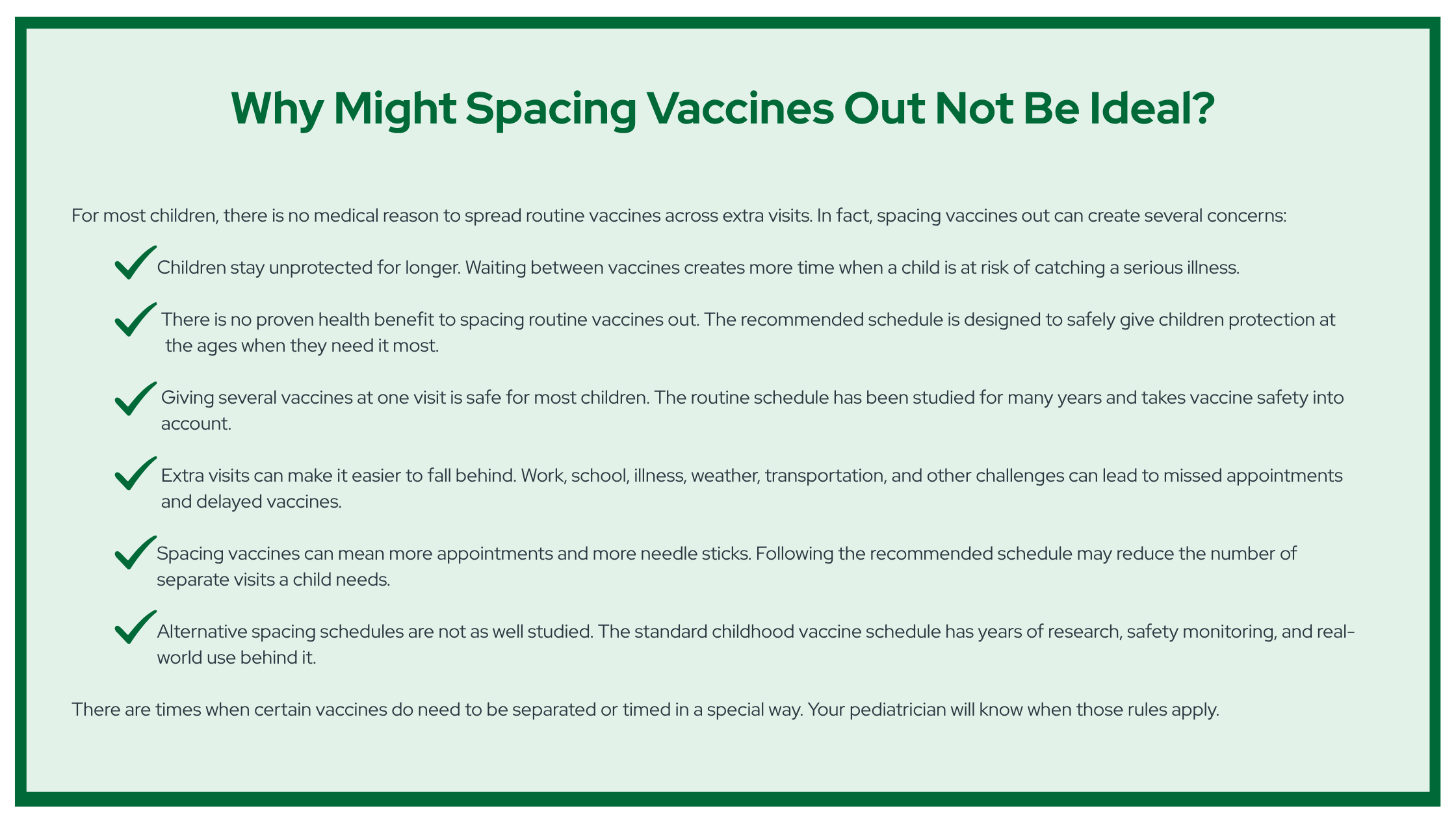
The timing of each vaccine is not random and is set using evidence-based research.
Vaccines are recommended at certain ages because doctors want children protected before they are most likely to become very sick from a disease. They are also timed for ages when a child’s immune system can respond well.
For example, babies and young children can become very sick from diseases such as whooping cough, measles, flu, and pneumococcal disease. Delaying a vaccine does not make that risk go away. In fact, children are left without protection for a longer period of time.
What About Getting Several Vaccines at One Visit?
I understand why receiving several vaccines in a visit can worry parents. Seeing your baby or child receive several shots at once can be difficult.
Remember that a child’s immune system handles contact with germs every day. Vaccines expose the immune system to a very small number of substances that teach it how to fight certain diseases.
The United States Centers for Disease Control agrees that children can safely receive several recommended vaccines during one visit. Giving vaccines together helps children get protected sooner and can mean fewer trips to the doctor.
What Should Parents Do Now?
You do not need to change your child’s vaccine schedule because of the new executive order.
If your child is due for vaccines, keep the appointment. If your child has fallen behind, talk with your pediatrician about how to catch up.
And if you have questions about a vaccine, ask. Your pediatrician should be a place where you can talk openly about your concerns.
Parents and pediatricians share the same goal: keeping children healthy.
For New Hampshire families, we continue to recommend following the evidence-based childhood vaccine schedule from the American Academy of Pediatrics. The schedule they have outlined gives children protection when they need it and is backed by years of research, safety monitoring, and real-world use.
Find the right pediatrician for your family
 Dr. Danielle Dunetz is a fellow of the American Academy of Pediatrics and a member of the American Osteopathic Association, practicing at Partners in Pediatrics of Southern New Hampshire Health, your non-profit healthcare partner in Nashua, New Hampshire.