
 My Chart Patient Portal
 Language Services
 Medical Records
 News & Articles
 Charitable Giving
 Programs & Classes
June 11, 2026
Water Safety for Kids: Simple Steps That Can Save Lives
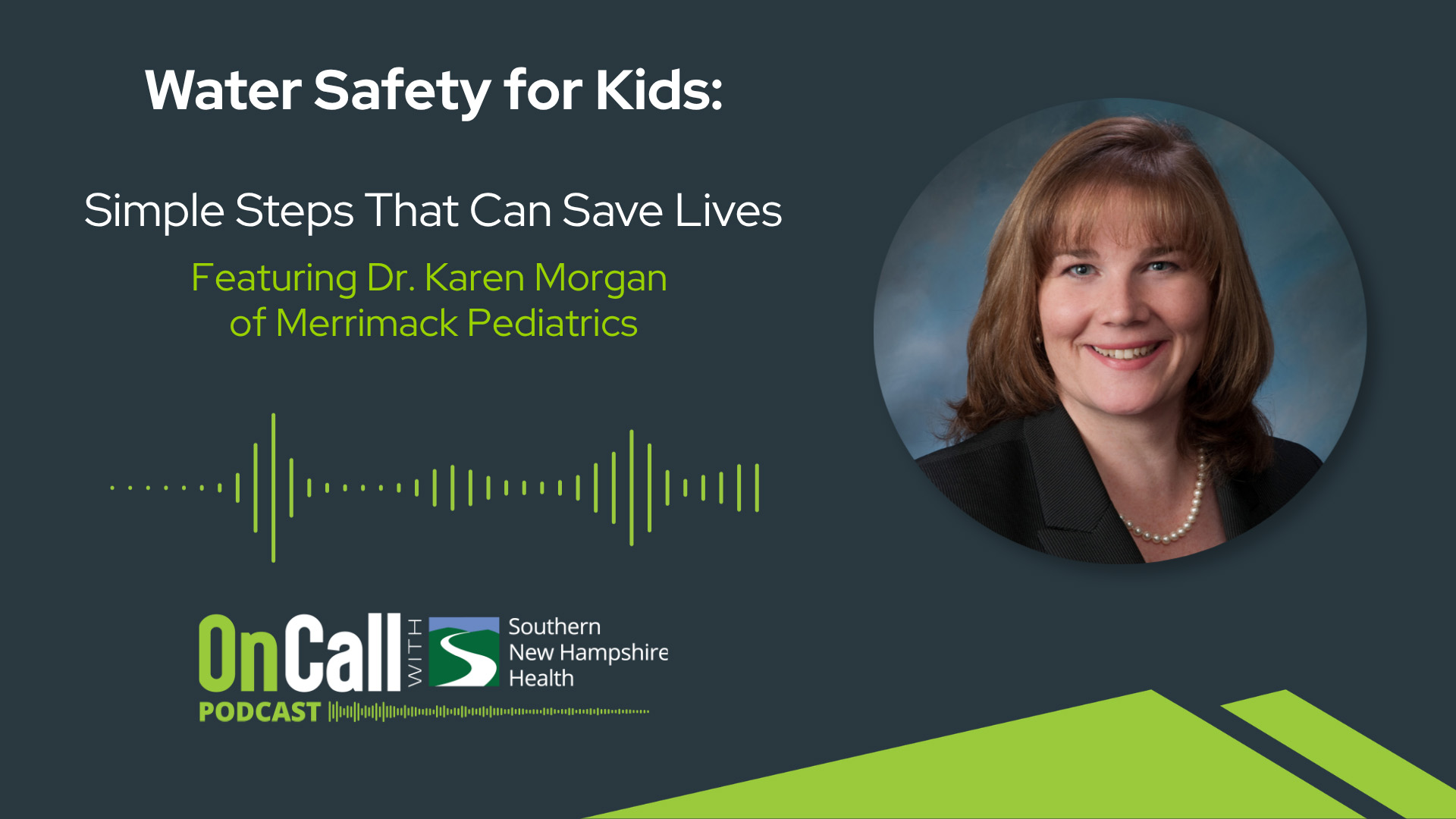
From pool days and beach trips to backyard cookouts where kiddie pools, buckets, and coolers may be nearby, water is a big part of summer fun, but it also comes with real risks for young children.
In this episode of On Call with Southern New Hampshire Health, we talk with Dr. Karen Morgan, a pediatrician at Southern New Hampshire Health’s Merrimack Pediatrics, about how parents, grandparents, and caregivers can help prevent drowning and keep children safe around water.
Dr. Morgan shares practical guidance on hidden water hazards around the home, pool safety, life jackets, swimming lessons, supervision, CPR, and what families should know before visiting lakes, rivers, or the ocean. With the right layers of protection, water can stay safe, fun, and enjoyable for the whole family.
Learn more about Dr. Karen Morgan and Merrimack Pediatrics
Complete Podcast Transcript:
Host (Keith Baldi): On Call with Southern New Hampshire Health. I'm your host, Keith Baldi. On Call delivers the latest health care news and updates, along with insights into the latest medical innovations and technologies. Southern New Hampshire Health is a nonprofit system serving the communities in greater national and New Hampshire and northern Massachusetts. The health system includes a 188-bed hospital, one of southern New Hampshire's most comprehensive teams of primary and specialty care providers, and five walk-in Immediate Care locations open seven days a week for urgent needs.
Southern New Hampshire Health- expert care, close to home. Thanks for joining us for this episode of On Call. Today, we're discussing a really important topic: water safety for children. Being around water is something so many parents and grandparents worry about, and rightly so. There's a lot to think about here to help us understand the concerns and make sure being in and around the water is safe and fun.
Joining us today is Dr. Karen Morgan, a pediatrician at Southern New Hampshire Health's Merrimack Pediatrics. Doctor Morgan, thanks for joining us.
Dr. Karen Morgan: Thank you for having me today.
Host (Keith Baldi): So, you've been on the podcast before, and we talked about being a pediatrician. And you really like treating families and children. Part of what you do is trying to prevent things from ever happening. Right?
Dr. Karen Morgan: Yes, absolutely. A big part of my job is actually to inform and discuss ways to prevent different dangers of our life, especially one of the things that comes to mind, especially since we talk about this today, is talking about drownings and how to prevent drownings and water safety.
Host (Keith Baldi): Yeah, that's it is a concern.
Dr. Karen Morgan: It is a concern. And just reviewing some of the more recent statistics for today's podcast, it was impressive numbers I found. I was seeing that overall across the country, 4,500 drownings and deaths happened yearly, which was an impressive number.
Host (Keith Baldi): That's crazy, right? You know, I know people are concerned about it. Being a parent, I always worried about it. When you see those numbers, it makes it a little more real.
Dr. Karen Morgan: When it comes down to it, 12 deaths a day are occurring across the nation. That's just it's a scary number, and it's very preventable.
Host (Keith Baldi): Absolutely. So being in and around water is fun. Many people enjoy the water pools, the beach, and we'll get to all that kind of water safety in a bit. But let's start with the fact that children can drown in an inch of water. That may seem extreme, but it's real.
Dr. Karen Morgan: No, it absolutely is. Especially in toddlers. They're so little. They're curious, they're impulsive, and their heads are actually disproportionate. They're actually very top-heavy. Their heads are larger than their bodies. And this is how the drowning occurs in just inches of water. It's impressive because this is actually the leading cause of death in the nation for toddlers ages 1 to 4, about 600 to 700 deaths per year are happening in toddlers.
And this is why it's so important that I talk to parents every day in the practice about two ways to prevent drownings.
Host (Keith Baldi): You know, one of the things that I remember as a new parent was proofing the house for kids, you know, child proofing the house, things like outlets and whatever else. There probably needs to be more discussion in general among parents about water safety.
Dr. Karen Morgan: Yeah. I think once we start hitting the spring and summer, we end up starting to talk a little bit more about pool safety and stuff. You know, in the wintertime, we talk about the wood stoves and all that, but I think we tend to talk about whatever season that we're in. But it is important to talk to you about all of these things because people go on vacations and stuff.
So, you always want to capture that moment and just educate, since it is a leading cause of death among toddlers.
Host (Keith Baldi): And so an inch of water. So, one of the things that in doing research for the podcast was I read a list of places where children can drown. And honestly, some of these are eye-opening: buckets, diaper pails, toilets, ice chests with melted ice. Didn't even think of that one. That makes perfect sense for a summer barbecue. You're watching the pool and, God forbid, you know a child drowns in an ice chest, hot tub, spa, whirlpools, ditches and post holes, wells, ponds, and decorative garden fountains.
That's another one. So what's your advice to parents for dealing with these types of things?
Dr. Karen Morgan: Just some simple prevention you can do? One of the things I remember is that someone always told me about garden buckets. You know as the rainwater comes, the little mosquito larvae get out there, and the kids get curious. So, they look in and then all of a sudden they just don't have that coordination to lift their head back up because they're so top-heavy.
So emptying buckets of water immediately and draining kiddie pools after use. I think a lot of people just think, "Oh, it's little, it's just sitting there.” But actually, that's a way, again, just a couple of inches of water, and that's a hazard there. So, make sure you empty those kiddie pools afterwards. Closing the bathroom doors again. So that way you can avoid that toilet water.
And then just watching children closely during gatherings, make sure someone is identified as the adult that's watching the children. I think a lot of times we start socializing, and we kind of let our guard down. And the biggest risk is that when everybody thinks someone else is watching, and that's the risk that we're that's when those accidents and injuries really happen and, God forbid, of drowning.
Host (Keith Baldi): And it's tough to when you're an adult, it's tough to visualize not being able to pick yourself up from an inch or two of water. Right. Your point is being so top-heavy.
Dr. Karen Morgan: Exactly. That's what to do, as much as you think they can, they actually cannot do.
Host (Keith Baldi): Which is you got to change your mentality as a parent a lot of times, for what's it like when you're, you know, two feet off the ground, what's it like when you can't pick yourself up those things?
Dr. Karen Morgan: So is that center of gravity, women, the center of gravity is their hips, and men, it's actually shoulders, and then toddlers, you know, they just don't have that ability because they're center is their head.
Host (Keith Baldi): So, swimming pools, it's a big issue right? We talked about other ways that kids can drown, certainly. But swimming pools, residential swimming pools are where most children drown. Such a fun place. But it's quite frightening. What's your advice for being around pools?
Dr. Karen Morgan: So, I think heading into the summer, we always want to have layers of protection and not just, “oh, they have swim lessons and they know how to swim.” I think sometimes it gets underestimated just how good even the best swimmer can drown. So, you want active supervision. So, there's something called touch supervision. So, in toddlers, you want to be within arm's reach of that toddler.
And then four-sided fencing around pools or gates, and self-latching gates. Swim lessons are always helpful. But remember, even the swim lessons do not prevent drowning. It will help, maybe buy some time, but it is still not going to prevent drowning. And then the Coast Guard approved life jackets. You know we have these swimming floaters.
Those are not Coast Guard-approved life jackets or pool alarms. And then of course, another thing you can also do is take a CPR training. So that way you can at least initiate CPR to at least get that initiated before help comes.
Host (Keith Baldi): Which is important when parents think about what they can do, all these things that they can do, they can try to make sure that they're watching their children closely. They can try to have prevention methods around all the things that you just mentioned, which are so great. But sometimes the kids just, you know, get away from us. That's just part of life.
And so other things that you can do CPR is, it seems like for a lot of people, oh, I have to go to a class. It's not a long class. And why as a pediatrician, you know why those minutes can matter. Can you talk a little bit about that?
Dr. Karen Morgan: Yeah, absolutely. Because within just a few minutes, you certainly can start having brain death. The brain injury and the nerves start dying. And you just want it. Every second counts. Absolutely. And you just want to really want to prevent that.
Host (Keith Baldi): Sure. So if people out there are thinking about something they can do proactively to try to at least set themselves up to help. Taking a CPR class is a great thing. It's most times now, hands-only CPR. You don't even have to worry about breathing.
Dr. Karen Morgan: Every second that you intervene, it improves the outcome.
Host (Keith Baldi): Absolutely. So we talked a little bit about pools other bodies of water. So, swimming pools are a huge danger. But in a controlled environment, in some ways right. Because you can be around them. But then you get into lakes, ponds, rivers, and a lot of people like to go cool off in the ocean. What makes these different?
Dr. Karen Morgan: Open bodies of water? There are so many more hazards there. You have currents, waves, and just the sheer cold of the water. Right now, we're living in New England. I think the ocean temperatures in the 50 degrees right now. And then you also have undertow you have to be careful about. And then just a sudden drop-offs that can happen.
So these are all things you have no idea where you just see water. You really don't know the depth or anything like that. So, for older children and adolescents, it's about 3 to 400 deaths per year that occur. Some things we can do are make sure that they just don't want to have those pool noodles. You actually really want to have those Coast Guard-approved life jackets.
Host (Keith Baldi): For sure. And there's a difference, right? That's why they're approved by the Coast Guard. Because they're meant to. And there are different levels. They're meant to keep you above. They're meant to keep your head up.
So, inside the jacket will be the weight. And you need to just make sure that you're in the correct weight range. Don't go buy a size up and say, oh well, they'll grow into it because you really need to do that right at that time. Once you snap it all in, you actually want to lift the child up by the shoulders with that life jacket and see if they slip out.
If it goes up to your chin, that's not a safe life jacket. That's going to be a hazard. So you really want to make sure it fits snug, and it doesn't move at all when you tug on that shoulder.
Host (Keith Baldi): That's great advice. So, when we think of drowning, a lot of times people just, if they haven't experienced, God forbid, experience someone having trouble swimming, they think of a movie where someone is out in the middle of the ocean saying, “help, help. I can't, I can't stay up, I can't float,” whatever. That's not always the case.
Dr. Karen Morgan: No. And that's what's scariest, is that these young toddlers, 1 to 4, they don't yell, they don't splash, and it happens very quickly.
Host (Keith Baldi): So that's why these layers of protection you're talking about are so important.
Dr. Karen Morgan: Absolutely.
Host (Keith Baldi): There's another thing about water that you know that people need to think about, that's diving into it. So, when we talk about boating and, you know, you just went over some of the suggestions about boating, wearing your life vest. But people go out, they want to jump off the boat.
And every year we do have a spinal cord injury because someone just does that, that risky behavior and just does do a dive headfirst, you know, go into a belly flop, you know, it might hurt a little bit, but at least you know, you won't end up with a spinal injury, you know.
Host (Keith Baldi): Yeah, that's also because we live in New England, we have had droughts, and the bodies of water change. And so you might think, oh no, we dive here all the time. It's lower. Maybe a rock moved, all those things.
Dr. Karen Morgan: All of those things. And then again, heavy rain in the water rises. And then all of a sudden it drops. And then there are rocks that are down there too, especially in a lower drought year. Those rocks are actually a lot closer to the surface. And that increased the risk of hurting. If we dive in headfirst, we can injure our heads too.
Host (Keith Baldi): Absolutely. And that that means even if you're the best swimmer. Absolutely. You won't have a chance. And you could if you're by yourself, obviously, and you hit the hit the bottom, then you could have a problem. So all this is great information, but we talked about a lot. What are some of the takeaways here.
Dr. Karen Morgan: Takeaways. Drowning is preventable. There are always those freak accidents that happen. But you know, with proper layers of protection, we absolutely can reduce some of these drownings that are very preventable. Water should be fun. And we shouldn't have to be afraid of it. Using those layers of protection, supervision, fencing, swim lessons, getting our life jackets, and then more importantly, if someone is CPR certified, that's even better.
Host (Keith Baldi): Okay, well, thank you so much. That's so much good information for parents, friends, family, grandparents, those who are watching children, or just for yourself, for some of the things that we talked about to stay safe, and to your point, to have fun. Yes. That's great. Thanks so much.
As we wrap up, I just want to mention that Southern New Hampshire Health has a great way to make sure you can find the best primary care provider available.
Like Doctor Morgan. You can call 1-880-EASY. That's 1-880-3279. You'll be matched with someone who best fits your needs. Dr. Karen Morgan, a pediatrician at Southern New Hampshire Health's Merrimack Pediatrics. Thanks so much for the discussion.
Dr. Karen Morgan: Thank you so much for having me.
Host (Keith Baldi): You've been listening to On Call with Southern New Hampshire Health.
For more information about the health system, or to learn more about some of the topics featured in this podcast, visit us on social media and on our website. SNHHealth.org.