

 My Chart Patient Portal
 Language Services
 Medical Records
 News & Articles
 Charitable Giving
 Programs & Classes
November 12, 2026
Your Guide to Holiday Eating on GLP-1s
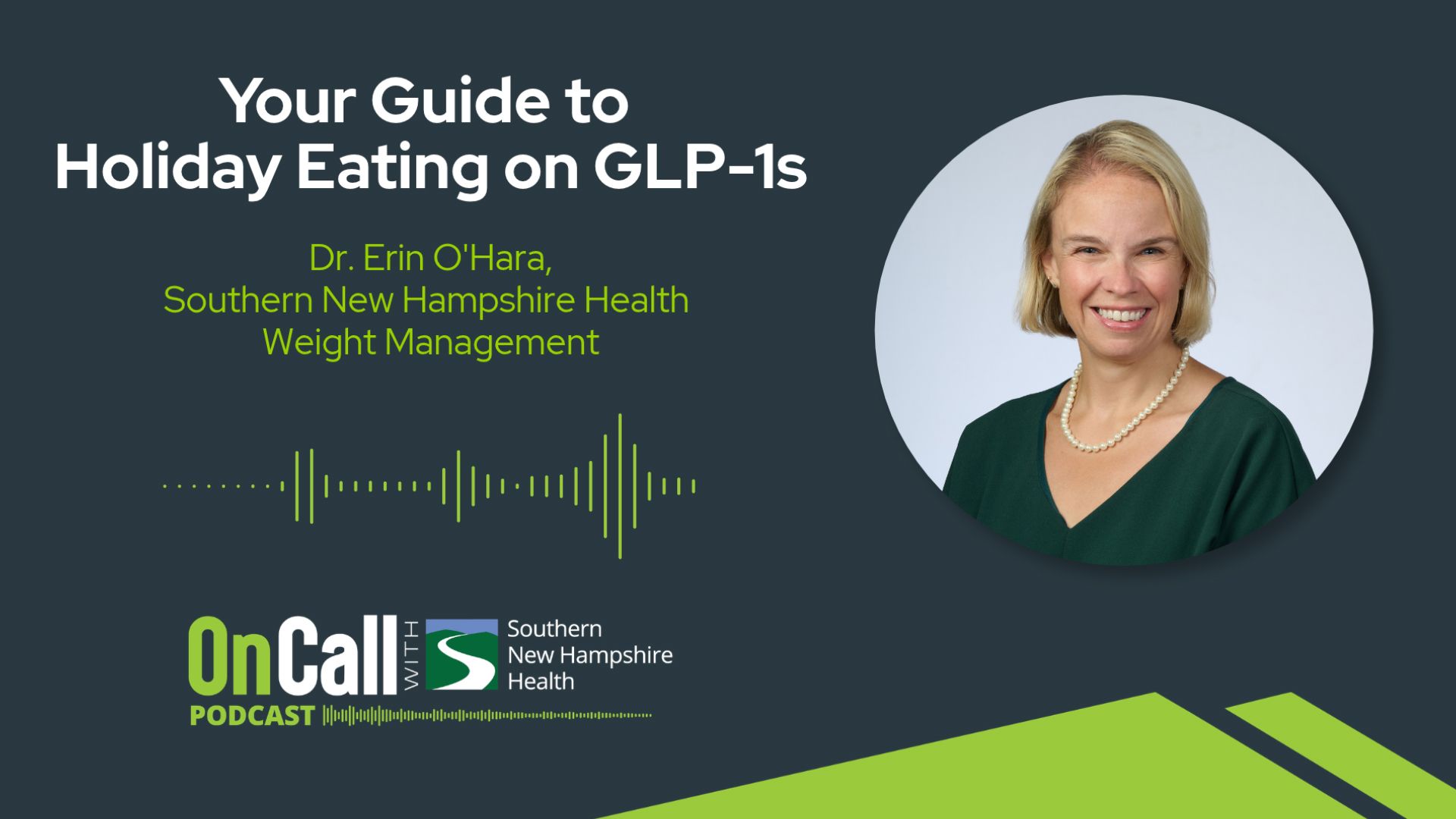
Holiday celebrations often revolve around food, but how can you enjoy your favorite traditions while taking GLP-1 medications?
In this episode of On Call with Southern New Hampshire Health, Dr. Erin O'Hara of Southern New Hampshire Health Weight Management shares practical tips for navigating holiday meals while taking GLP-1 medications. From managing portions and making mindful food choices to understanding how alcohol and rich foods may affect you, Dr. O'Hara explains how to enjoy the season while staying on track with your health goals.
Learn About Southern NH Weight Management
Complete Transcript:
Keith Baldi, Host
Welcome to On Call with Southern New Hampshire Health. I'm your host, Keith Baldi. On Call delivers the latest healthcare news and updates along with insights into the latest medical innovations and technologies. Southern New Hampshire Health is a nonprofit system serving the communities in Greater Nashua, New Hampshire and Northern Massachusetts. The health system includes a 188-bed hospital, one of Southern New Hampshire's most comprehensive teams of primary and specialty care providers, and five walk-in immediate care locations open seven days a week for urgent needs. Southern New Hampshire Health, expert care, close to home.
Thanks for joining us for this episode of On Call with Southern New Hampshire Health. The holidays are a time for family, friends, celebration, and, of course, great food, but for some people, worrying about what to eat and what to turn down can cause anxiety, especially if you're on a GLP-1 weight loss drug.
We have Dr. Erin O'Hara with us today. She's a physician at Southern New Hampshire Health Weight Management. She's going to help us navigate GLP-1s during the holidays. Dr. O'Hara, thanks for joining us.
Dr. Erin O'Hara, Southern NH Weight Management
Thanks for having me, Keith. Happy to be here.
Keith Baldi
So before we start on the topic, we'd just like to get to know our guests a little bit. Tell me a little bit about yourself and why you chose this specialty.
Dr. Erin O'Hara
Absolutely. So, I've been practicing obesity medicine now for about 7 years. Prior to that, I was working in primary care with both pediatrics and adults. I trained in internal medicine and pediatrics and then wound up getting my board certification in obesity medicine. So, I'm now triple board-certified and have transitioned my practice from primary care to strictly obesity medicine. I got into it seven or eight years ago, actually, because I was teaching a nurse practitioner student who had a significant interest in obesity medicine. And in learning about it with her and alongside her, I found a passion for it that I didn't realize I could have. And it led me down this path.
Keith Baldi
That's fantastic. And it does touch a lot of different parts of medicine. So you really can make a difference.
Dr. Erin O'Hara
Absolutely. Absolutely.
Keith Baldi
Fantastic. So before we start the discussion about GLP-1s and the holidays, I feel like we need to talk about food at the holidays in general, because it's a time when people feel pressure to eat. They often overeat. They express their thanks, which is wonderful for others, by making food and sweets. My daughter makes incredible cookies, so you know, but it's her love language, right? So this happens. But so what's a guiding principle for you when it comes to food at this time of year?
Dr. Erin O'Hara
Food at this time of year is something that you have to look at in little chunks. So I often will tell my patients that between Halloween and Valentine's Day, it's a really tough time of year for folks who struggle with weight and who are trying to eat healthy. So I encourage them, and I encourage everyone, to enjoy the holiday, Thanksgiving, enjoy the meal, but it's one meal, and then you're done. So enjoy it. Plan what you like; plan what's important to you. If you love grandma's green bean casserole, have it, enjoy it, but then skip the things that don't mean anything to you, the things that you don't enjoy. You don't enjoy the stuffing; you don't have to have it. And by planning that and by leaving the meal at the meal and not continuing to eat it for the next three weeks, you can really enjoy your holiday while still maintaining a healthy lifestyle.
Keith Baldi
That's so important and so interesting too, because you do, these meals tend to linger forever, right? Especially, you know, we don't want to waste food, and that's important. And then you put it in the fridge, but then you come back to it, or maybe you take some home. So if you're not hosting, a simple no, thank you, mate, you know, for taking things home, right? That's.
Dr. Erin O'Hara
Exactly. And if you are hosting, send it all out the door.
Keith Baldi
Perfect. And there are many people who are willing to take it. So all right, so let's shift the focus a little bit to GLP-1s. We talk about these so much nowadays, but not everyone even knows what they are or if they've heard of them; not really sure what they do or how they work. I know GLP-1s have been around; this type of medicine has been around for a while, but we have just been hearing about it as a collective, I feel like in the last couple of years. What's going on here?
Dr. Erin O'Hara
Correct. GLP-1s have been around since the early 2000s. They were initially developed to treat type 2 diabetes. And we know that a lot of the underlying foundation of obesity is the underlying foundation of type 2 diabetes. So it makes sense that these medications that help treat type 2 diabetes also can help patients who have obesity and overweight treat it before they develop type 2 diabetes.
GLP-1 is a hormone that we naturally produce in our gut. And one of the things it does is it makes you feel full. It tells your brain that you're full. And so by taking them and increasing the activity of that hormone, you're telling yourself you're full earlier than you would normally.
Keith Baldi
That makes sense. So it's tricking in a way, but in a good way, because these can really lead to people cutting back.
Dr. Erin O'Hara
Exactly. People find that they feel fuller longer and faster. And part of that is because it's a gut hormone; it slows down how quickly your stomach and your gut move. So you don't empty as quickly, and you feel full.
Keith Baldi
That makes sense. Is it fair to say these drugs have changed the way that you approach your job? And talk a little bit about that.
Dr. Erin O'Hara
Absolutely. They have been groundbreaking in how we treat patients with overweight and obesity. There's no magic bullet, right? Like GLP-1s, like anything else, are tools in our toolbox. But it's like going from the handheld Phillips head screw to the power drill for us. And for patients, they find that the effects of these medications are remarkable. We've taken the perception of willpower out of losing weight with these and really turned it into something that we know is biological. And we've known that. Now we have proof, which is huge, both to validate what patients experience and also to help treat them. Because if we treat their biology, then they get better.
Keith Baldi, Host
And it’s important to have a physician, a nurse practitioner, a clinician with you along the way. I know there are so many ways to get GLP-1s now. I mean, just turn on your television or watch a show, right? And the commercials come through. But to your point, it's important to have someone with you on that journey because it's not just take a pill and walk away.
Dr. Erin O'Hara
Correct, correct. You still need to have someone coaching you, supporting you. walking the journey with you, but also making sure that we're not doing damage. Any type of weight loss can lead to muscle mass loss. And that's never our goal. Our goal is always to help patients with fat mass loss. And these medications are tremendous at it. But if you're not fueling your body properly, then you're going to lose more muscle than you want and cause other problems. So you really do need someone walking that journey with you, checking in, being that sounding board, being someone to help you tweak what you're doing in order to have the most success.
Keith Baldi
Makes complete sense like anything in healthcare. Don't diagnose yourself through ChatGPT. Okay, there's my public service announcement for the day. So portion sizes, focus on the holidays because I'm sure portion sizes are something you talk with people throughout the year, but the pressure is a little different. When, like you said, you have your grandmother's green bean casserole, but then you also have your Aunt Sue's chocolate cream pie and whatever. There's a lot to look at. So what advice do you have for people on GLP-1s when it comes to portions and making good overall choices?
Dr. Erin O'Hara
Plan ahead. So A #1, don't go hungry. If you get hungry. Patients on GLP-1s often aren't overly hungry, but never go hungry. Plan ahead, have something with some protein or healthy fat, along with maybe a little bit of a complex carbohydrate before you go so you're not starving. And then when you get there, if, and people are like me, I cook the same meal for, you know, each Christmas dinner is the same every year. If you know what you're gonna have and what's gonna be on the table, plan ahead. I love these three things. I'm gonna have small portions of that. Skip the rest. If you don't, survey the dinner table and make that decision of what I'm gonna have, you know, here's my protein, here's my vegetable, and then take it from there. When you take the food, because there are often way more choices available at Thanksgiving or Christmas or any of the holidays versus, you know, a regular Friday night dinner. Take small amounts, take a tablespoon, take a small piece. You can always go back for more if you want it, but then if you have a small amount, you're less likely to overeat. Use a smaller plate; use a salad plate as opposed to a dinner plate. That will help shrink your portions down and give you an idea of what you should be at. And then, most importantly, especially for patients on GLP-1s, you want to stop when you feel full. With GLP-1s, if food is sitting in your stomach, it's going to cause nausea and vomiting if you overeat. So you want to make sure you stop when you feel full and tell people, I'm full, I'm good, I'm done.
Keith Baldi
Right. And these are obviously a lot of times family and friend gatherings. People should understand that and be supportive. And to your point, if they are family and friends, you can always ask ahead of time, "Oh, what are you planning to make?” And make it a discussion. Doesn't have to be a thing, right? But just show some interest. I'm gonna bring this. What are you having? And then going into it, you have that in your head, right?
Dr. Erin O'Hara
Exactly.
Keith Baldi
Okay, so is there ever a scenario where a patient would skip a dose in order to indulge? I know this seems counterintuitive to me, but what's the message about doses?
Dr. Erin O'Hara
We really discourage that. And it's for a couple of reasons. The GLP-1s take a while to build up in your system to an effective dose. And skipping a dose because you're having a procedure or something typically is okay, but you don't want to skip it to eat. It's honestly probably not going to flush out fast enough to cause you to be very, very hungry. And you could have side effects from going back onto it. Nausea and vomiting, for some people can be really predominant when they're changing their dose or adjusting it. And you don't want to have to do that a couple days after Thanksgiving or during the holidays. These meds are tools, and it's part of the lifestyle change. So we very much encourage patients to incorporate this as part of their lifestyle changes, so they're not adjusting their meds based on their holidays, vacations, time off, things like that.
Keith Baldi
Get used to it as part of your life, and then you wouldn't; then you can deal with it and make plans rather than just deciding to skip it.
Dr. Erin O'Hara
Exactly.
Keith Baldi
No, that makes complete sense. So don't avoid the dose, but what foods should you avoid? I mean, there tends to be so much food at holiday gatherings, and it's great, but some of it's- you got ham, lasagna, these rich foods; you can tell where my mind is apparently, but pies, gravy, there are so many things that I love, but it's a real thing for a lot of people because you do have those memories and, as you're saying, you have your favorites, but in general, what should people on GLP-1s try to avoid?
Dr. Erin O'Hara
There's no forbidden food on a GLP-1. Everyone reacts differently. And just in my experience, I've had patients not do well on any variety: high carb, high sugar, high fat. Really, it comes down to knowing you and adjusting to what you do. And we have patients who don't react to any of it, and that's okay too. They've really got to kind of plan for themselves. In general, we say avoid the high saturated fat foods. They tend to sit longer. They tend to cause more nausea and reflux, but it could be anything. So it's an individual patient's profile.
Keith Baldi
Fantastic. And part of life with many people, whatever, sure. Foods to enjoy. I know that, fortunately, nowadays in 2026, there are more foods that are healthier presented in a lot of meals. People are feeling a little more health-conscious. At least I find there are always some options. So what would those options be? What would your advice be to someone on a GLP-1 who goes and looks at that in surveying the table, as you put it, which is a great way to think about it? What should they survey for?
Dr. Erin O'Hara
Really, first off is always protein. We are always, always pushing protein because that's what helps preserve that muscle mass. So even Thanksgiving dinner, you want to look for your protein first. And that can be turkey, ham, tofu, tofurkey, beans, lentils, anything that's got protein in it. You really want to get that in first. And then fill in with your fruits, your vegetables. Those are often next up with healthy fats. So a little bit of butter on your vegetables is fine. And then your complex carbohydrates. And those really should be the last thing you fill in with if you're still hungry, if you still have room. Again, with the caveat that, you know, if you love Grandma's dressing, have some; don't deprive yourself. Have it, be mindful about it, enjoy it and savor it, but try to balance it with that protein and that healthy fat.
Keith Baldi
Absolutely. Also at the holidays, I mean, this is an issue I'm sure with the patients all the time: alcohol. People drink casually throughout the year, but when we're at the holidays, people do have special drinks, or they want to indulge a little bit. And so much about GLP-1s obviously is about food, but what's the alcohol factor in all of this, and how does that play into things?
Dr. Erin O'Hara
Good question. Alcohol, much like any other food, is not prohibited with GLP-1 use. Again, because the stomach empties more slowly, alcohol can hit differently. And oftentimes people are a little bit more dehydrated on a GLP-1 because, just like the hunger goes away, thirst goes away. So we do encourage patients to be careful and don't, especially if they're new to the medication and haven't really drank on it before, don't assume that your usual 2 glasses of wine that you could drink and then drive home safely are still safe. You want to be careful. You want to plan for it. And you just want to be aware that you may get drunk faster. You may not be safe to drive. It may hit you harder. It may hit you longer. You may be hungover in the morning when you weren't before. So I don't encourage drinking on GLP-1s because of that. But from a medical standpoint, there's no reason to not, other than what I just said.
Keith Baldi
No, that's interesting. I've never heard that. So that's really good information. And some people who may not be regular alcohol drinkers may go to a party around the holidays and say, I might have; this is the time of year I do that. And if they're not, say, experienced, but with drinking while on a GLP-1, that could go poorly.
Dr. Erin O'Hara
Yes, rapidly.
Keith Baldi
Right, No, that's great advice. So, you know, we like to enjoy the holidays. We've already established that food is part of it. There are ways to make it better, to make it okay when you're at the holidays. But you want to make sure that it's not ruining your holiday, right? Because this is a special time of year for family. It doesn't have to ruin the holidays.
Dr. Erin O'Hara
Right, not at all. The holidays are about being with family. The food is something cultural that we do to help celebrate the holidays. And culturally, we use food for a lot. You want to go see a friend, you have lunch or dinner, you don't go for a walk. I am a big advocate for changing that narrative. And yes, food is part of it. We're never going to not have Thanksgiving dinner or Christmas dinner or any of the holidays. Food with them, but make it a tradition that after you eat, you go for a walk or you go play a little touch football or do something active to try to build something else around the holidays. And it's not just eat a big Thanksgiving dinner and go sit on the couch and watch the football games all day.
Keith Baldi
No, those kinds of things are fun. And it's a good chance to connect with your family or friends in a different way too. So that's great advice. But as we wrap up, is there one message you kind of want to drive home for people? I mean, we've touched on so many things, but I would just like to give the guest a quick chance to summarize if they want.
Dr. Erin O'Hara
I would say GLP-1s are a tool. They're a phenomenal tool, but they're a tool. And it's okay to use that tool, but also to enjoy the holiday. So pick and choose your battles. And the things that are important to you, enjoy and savor, and the things that aren't, let them go.
Keith Baldi
Such great information and great perspective. Before we go, I just want to mention that Southern New Hampshire Health has a great way to make sure you can find the best primary care provider available. You can call 1-880-EASY. That's 1-880-3279. You'll be matched with someone who best fits your needs. Dr. Erin O'Hara, a physician at Southern New Hampshire Health Weight Management. Thank you so much.
Dr. Erin O'Hara
Thank you.
Keith Baldi
You've been listening to On Call from Southern New Hampshire Health. For more information about the health system or to learn more about some of the topics featured in this podcast, visit us on social media and on our website, snhhealth.org.