
 My Chart Patient Portal
 Language Services
 Medical Records
 News & Articles
 Charitable Giving
 Programs & Classes
November 2, 2026
You're Not Alone Feeling Lonely: Reasons People Experience Loneliness and How to Manage Those Feelings
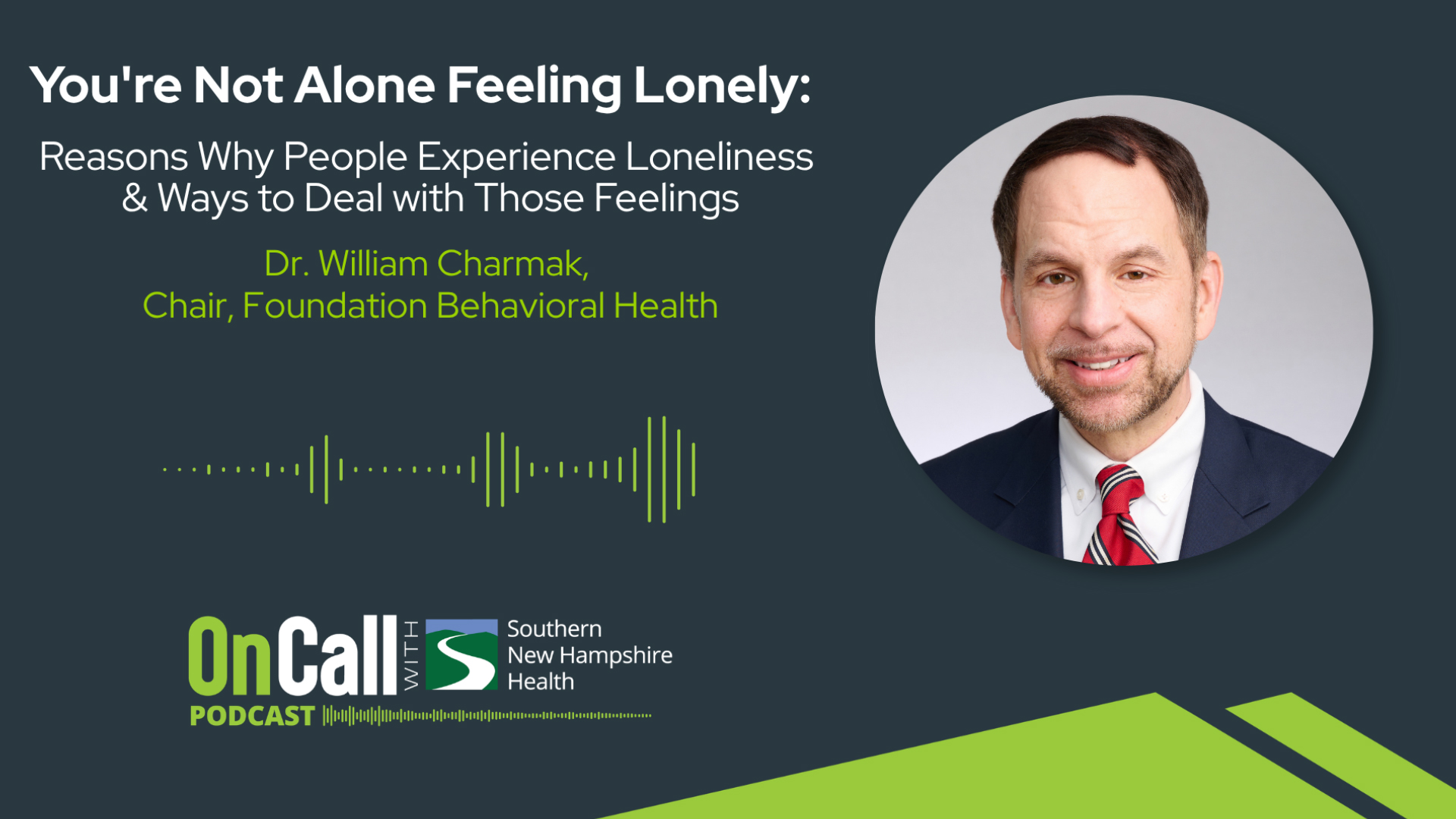
You can be surrounded by people and still feel lonely. While spending time alone can be healthy, feeling disconnected from others can take a toll on both your mental and physical health. And loneliness can affect anyone, regardless of age or circumstances.
In this episode of On Call with Southern New Hampshire Health, we sit down with William Charmak, PhD, Chair of Foundation Behavioral Health, to explore why loneliness is becoming increasingly common, how social media and changing lifestyles affect our relationships, and the surprising ways loneliness can impact our health.
Dr. Charmak also shares practical advice for building meaningful connections, including how small, everyday interactions can make a big difference. Whether you're experiencing loneliness yourself or concerned about someone you love, this conversation offers valuable insights into the importance of human connection.
Complete Transcript:
Keith Baldi
Welcome to On Call with Southern New Hampshire Health. I'm your host, Keith Baldi. On Call delivers the latest healthcare news and updates along with insights into the latest medical innovations and technologies. Southern New Hampshire Health is a nonprofit system serving the communities in Greater Nashua, New Hampshire and northern Massachusetts. The health system includes a 188-bed hospital, one of Southern New Hampshire's most comprehensive teams of primary and specialty care providers, and five walk-in immediate care locations open seven days a week for urgent needs. Southern New Hampshire Health: expert care, close to home. Thank you for joining us for this episode of On Call.
Keith Baldi
Today is a day to focus on a mental health topic that has seemed to get a lot of attention from time to time since the COVID pandemic. That is loneliness. The British Medical Journal, known as BMJ, defines loneliness as the discrepancy between one's desired and actual social relationships.
But it goes beyond that simple definition, and loneliness can have a marked effect on people's mental and physical well-being. Today we have Dr. William Charmak joining us to discuss this. Dr. Charmak is the chair of Foundation Behavioral Health here at Southern New Hampshire Health. Dr. Charmak, thanks for joining us.
Dr. William Charmak
My pleasure. I'm happy to be here.
Keith Baldi
So before we launch into this topic, Doctor, which I know you're passionate about, we've discussed this before, I'd just really love to give our audience a quick snapshot of your really interesting career and how you came to Southern New Hampshire Health. Can you give us a quick overview?
Dr. William Charmak
Sure. Well, I hold a PhD in clinical psychology. I also hold a postdoctoral Master of Science in clinical psychopharmacology, and I'm board-certified in clinical psychology to practice. Interestingly, when I did my doctorate, I had to do a residency, and the military offered me that opportunity, and I did my residency at a military hospital in Washington, D.C. And not thinking I'd make a military career, I was a captain. I was offered a civilian position and just stayed there for 35 years. I retired and was looking for a place where I could sort of retire. And I came to Hampshire. I was offered a job at Mass General until a neighbor said, " Come to Southern.” And it's been wonderful.
Keith Baldi
That's fantastic. And we're very lucky to have you. I know people in the health system speak very highly of you. So this topic, as I said, I know that the reason for this podcast was because we were trading some ideas, I think, during another interaction. And I gave a quick definition of loneliness in the introduction to this episode, but there's a mental health charity called Mind. They also have an interesting definition. The feeling we have when our need for social contact and relationships is not met. From your work with patients and people you speak with, what do you think about that definition, and really how impactful is loneliness?
Dr. William Charmak
Well, first of all, I think it's not a bad definition per se, but what's missing, in my opinion, is the deep emotional pain that comes with loneliness. And it is not only psychological pain, but it can be physical pain. I think that people forget this: that our emotions can cause physical pain, like even anxiety and depression.
Keith Baldi
Yeah, absolutely. You know, when you talk to people, it's because obviously there's a whole range of behavioral health issues that you might address. How often are you hearing about this?
Dr. William Charmak
I'd say that it's been on the increase in the last 10 to 15 years. Our society has changed quite a bit. We're more isolated for several reasons. One thing that I even think about is that there are fewer places to meet people. There are fewer places to gather. I'm not talking about looking for dating venues per se, but people had neighborhood restaurants, and they had places to go, or bookstores. Now, like, sort of Barnes and Noble is it. If you want to meet a friend for a coffee or a Starbucks. And that's all very well and good, but they're limited options, per se.
Keith Baldi
Absolutely. So there's an important point I think to highlight too: when I was reading for this, there's a distinction between social isolation and loneliness, right? For some, being alone doesn't mean that you feel lonely. For others, you can be in a group of people quite often, and you can feel lonely.
Dr. William Charmak
Sure, there's something called healthy alone time. Sometimes we just have too much stimulation. We're tired. We've been interacting with people for a good long time, and we want to step back and recharge. And we can enjoy being alone and reading a book or taking a walk or doing a task. And that can be restorative, but not for any sustained amount of time. We were built to be social creatures. We know that children without good parenting early on, or even lack of contact, can grow with lots of psychological difficulties and physical difficulties. So we are communal social creatures to be with.
Keith Baldi
Did you see, I mean, obviously this issue was exacerbated by COVID because of isolation. But how did you see that?
Dr. William Charmak
So look, there's an overlap certainly between social isolation and loneliness. And where that line is, I think it depends on lots of circumstances. But COVID was more associated with social isolation because it was forced isolation. We were told not to go out. We were told that you couldn't go here or go there, and you had to keep social distance. So I may have been a very socially connected person, but suddenly that was just taken from me. And that wasn't easy. There are people I could not see, people with compromised immune systems that are related to, and I could not be with them. So that's what we understand to be social isolation.
Keith Baldi
And the idea of people being lonely, even though they're in large groups, or maybe it's somebody who works in a place where there's a lot of buzz at their office. Maybe there are a lot of things they have to do, a lot of people they have to meet, but they can still be lonely. That's an interesting concept, I think, for some people to understand.
Dr. William Charmak
It is interesting. And in fact, I think people also miss the point that you can feel lonely even in a relationship or a marriage. It's about not feeling validated. It's about not feeling understood. It's about not feeling like you count to others or that you're part of what's going on. Unfortunately, sometimes in large groups, we can alienate others. We're not inclusive. Unfortunately, we live in a narcissistic world too. And if you don't meet the criteria that we think are okay, you're here, but we're not going to include you. I talk about inviting people, but not welcoming them. There's a big difference.
Keith Baldi
So do you feel like some people, when they feel as though they don't belong?
Dr. William Charmak
Absolutely. You can feel invisible in social settings or that you can’t connect with people not connecting with you.
Keith Baldi
What do you see as the top causes or reasons for loneliness in the year 2026? The reason I say it like that is I think something you just pointed to is that times change, right? I mean, I'm assuming loneliness in 1826 looks a lot different than loneliness in 2026. What do you think some of the causes are?
Dr. William Charmak
They're very varied. I think certainly what we haven't done in parenting is also teach children social skills so they can connect with others. I don't see this happening as much as it was once the case, because I think also there are fewer venues. Yeah, you may be on the soccer team, or you may be on a baseball team, but it's sort of go in there, play, and how do you get along with people? How do you build and sustain relationships? Schools will not teach us how to do this; it has to come from home. And it's not a criticism of adults who are parenting children, but this is something that isn't necessarily a part of upbringing so much. There are lots of things to do, lots of things to focus on, and this can fall by the wayside. And we should talk about social graces, about being polite, how to connect with others, how to make small talk. I don't see that happening. And we have a lot of people that just know where to begin in terms of making social connections.
Keith Baldi
So that is, I think, a wonderful point. Who then, or how can you turn this around? Is it just more time with children? Is it more time with, like you said, these sort of happenstantial interactions where people no longer walk down the street? Do you have to kind of make that effort, even though it might seem weird?
Dr. William Charmak
You do. I mean, the other problem is that we've also become paranoid of one another too. We're not trusting one another, and I think there's a lot of negativity in terms of who may do what to you and what they're looking for or what their motives may be. And I think that some of that's overblown. Now, I don't mean you shouldn't be cautious and that you should use your awareness and say, if I'm not comfortable, I shouldn't continue. But people are, I think, poised to be mistrustful more than trusting, unfortunately. But in terms of helping children, it's awareness that this is happening and what I can do to make my child more resilient and to be able to connect and sustain friendships because I won't always be here as their parents. I can't be.
Keith Baldi
Right.
Dr. William Charmak
I want them to be able to meet and connect with healthy people. And those skills need to be taught.
Keith Baldi
So say that you were a child, and maybe you're our age, maybe you're a little younger, whatever it may be, and you didn't learn those skills. What do you tell patients, people who are listening, about that? How do you turn things around, so to speak?
Dr. William Charmak
So we have to begin somewhere. One thing I talk about is making micro connections with patients that you don't have to jump into a relationship and find out about all there is to know about someone in the first visit. But by saying hello, making small talk, saying something about the weather, introducing yourself. And this can happen at work. It doesn't mean not to have a sustainable relationship at work, but it's good practice. And it's the accumulation of those micro connections that can help you actually bridge into making greater connections with others at some point. And then patients also, or the people I work with, feel really pretty comfortable with this idea of a micro-connection. It's not so bad; I can say hello to somebody. We talk about, well, let them say hello back. And also be careful of feelings and projections that happen in those instances. Sometimes our feelings don't tell us the truth of what's happening. We're assuming, well, they didn't say hello to me, they don't like me, and that isn't true.
Keith Baldi
Don't read into everything. Yeah, no, absolutely. We all do that. You mentioned this at the beginning: that the impacts of mental health on physical health certainly are real. People don't realize. People don't always realize that. And it seems like there's been a lot of research done on loneliness, but it doesn't seem like there's one definitive study to say, oh, it causes X, Y, or Z, but it can have health effects. What are some of the things that you think people, I know it's probably A huge spectrum.
Dr. William Charmak
There's a reason why the Surgeon General came out a few years ago and said we have an epidemic of loneliness. And I'm not sure that the impact of that statement was taken as seriously as it should have, because what didn't come with that statement was the fact that we know that when you're feeling lonely, we can have physiological reactions. Our cortisol levels go up. This is a hormone that regulates a lot of our body functions, and that too much of this, when we're feeling lonely and that's a connection, can start to damage tissue. We know that loneliness and this raising cortisol can be associated with cardiovascular disease. It can even lead to weight gain, and that can start a whole avalanche of concerns in terms of self-esteem and feeling depressed and anxious. I don't think I look because I feel I need to look. But even this connection to dementia- and this is something we're saying over and over again- that making social connections as you age is extremely important for brain health, that we're keeping neurons firing. And these neurons that are associated with social interaction are really vital because they're connected to serotonin and dopamine, all these good neurotransmitters that help us feel well.
Keith Baldi
And there's an interesting, I think, dichotomy when you look at that kind of interaction that gives you dopamine, serotonin, and makes you feel better. And the kind that it seems like everyone focuses on in 2026 when someone hits a like button on a post that you make. That gives you an immediate rush. But it's a different, it's quite a different kind of.
Dr. William Charmak
Well, it's also very short-lived. Okay, well, it's done. Okay, and I don't have any connection to this person. I don't know who they are. Maybe it was a mistake that they did this. Who knows? There's nothing palpable about it.
Keith Baldi
No substance, but right. And I point that out because I just think a lot of people think, well, I have friends online, quote unquote friends, people who look at my posts and this, and you can feel that love, so to speak, but as you mentioned.
Dr. William Charmak
Right, and these are usually friends; people don't really know who they are or what they're about. And sometimes what people are presenting isn't really the truth about themselves anyway.
Keith Baldi
Do you see social media and technology, certainly people work from home more now, and these things are not going to be unraveled, right? So anytime soon, probably. Do you see that as a contributing factor?
Dr. William Charmak
Absolutely. I mean, it's very self-absorbing. We can lose a sense of time when we're scrolling on our phones or our laptops. And if we're not doing one thing, we're not doing another. So, if we're involved there, and I haven't lost time, but we could have maybe made a phone call to someone and had a deeper interaction.
Keith Baldi
I would say, if you're playing a game on your phone, you're not playing a game in person with somebody. To talk about a connection, those kinds of things, right? Playing a board game with somebody is a heck of a lot different than playing a board game by yourself.
Dr. William Charmak
It's not going to help you with social skills, but you're not practicing that. You're not also looking at how to read body language in other people. And looking at how to sustain a relationship. None of that's there.
Keith Baldi
Do you see, I'm assuming there are different specific age bands where you see these kinds of things. Do you put people into categories about where it might affect them?
Dr. William Charmak
Yes, sure. I mean, certainly younger people are affected by loneliness more than other groups. And we're talking about maybe from ages 16 through 25, 26. As of late, I should make a point here that I'm not talking about the 16- and 27-year-olds of 34 years ago; what I'm talking about now in terms of contemporary sense, that they have grown up with electronics and become self-absorbed with them and don't know how to make connections that are healthy and sustaining in many cases.
Keith Baldi
So you think the focus when it comes to psychology is that it needs to be more towards that. Not that obviously you can be lonely at any age.
Dr. William Charmak
Sure. I think the other thing that we're not really looking at is the fact that when people are connecting online with one another, sometimes they're doing this like all night long, or they're doing this after hours when it's impossible to have a face-to-face interaction with someone else. So, it's taken people out of that window in terms of, you know, connecting with others.
Keith Baldi
So, we always discuss, we try to give people some advice to help deal with this. What would you say to somebody who's listening to this and saying, " This is really clicking with me or my son or daughter or my mother or father?” What do you think?
Dr. William Charmak
Sure. I just want to point out quickly that there are loneliness challenges in middle age for people and for the elderly, certainly.
Keith Baldi
Of course.
Dr. William Charmak
In terms of social isolation, people who are caregivers, people who are handicapped, people who are not able to access society as you and I are, experience that all the time. And there's going to be a lot of loneliness that comes with that.
Keith Baldi
Of course.
Dr. William Charmak
But in terms of what to do, well, certainly if you have a disability or if you're a caretaker, there are specifics that you can plug into that I won't go into here, but saying that I would like to have more contact with someone. One of the best ways of doing this, and I say this to patients all the time, is volunteering. Why I like volunteering is that usually you're picking an activity I think I would like to do that will maybe have some impact in terms of what I'm involved in, whether it's taking care of a local park or I'm helping out in the hospital or whatever it might be. But I'm also going to meet like-minded people; this is going to attract people who are probably thinking like me. Now, I can't guarantee that, but it's likely. And this is why we're drawn to groups, because we think they seem to feel and think like I do, and I'll be comfortable there.
Keith Baldi
That's a great point. And it's a great idea too. And that's something that's not super difficult to do. There are so many opportunities, right, and so many reasons to help. And as you said, it gives you a sense of self-worth too, right? I mean, that's...
Dr. William Charmak
And even if you have a relationship in those settings and the relationship ends because someone leaves, you still have the activity to sustain you. And obviously people are going to backfill those positions, and you'll meet others.
Keith Baldi
Okay. Well, thank you very much for this conversation. It was great, and I think a lot of good information, and I always think these kinds of topics allow people to recognize that they're not alone in this. Especially when you feel lonely, you may feel like no one understands.
Dr. William Charmak
No, but I want to say something really quickly. And that is, if you are suffering from anxiety or depression, you want to take care of that first. These are not in any way sort of cures for getting over depression or anxiety. These are diagnostic conditions that require professional assistance. Now, loneliness and anxiety can come in the context of depression or other mental health illnesses, but those things need treatment first.
Keith Baldi
Absolutely. Thank you. All right, and as we wrap up, I just want to mention that Southern New Hampshire Health has a great way to make sure you can find the best primary care provider available and then be connected to other specialties and services we have here. You can call 1-880-EASY. That's 1-880-3279. You'll be matched with someone who best fits your needs. Dr. William Charmak, chair of Foundation Behavioral Health here at Southern New Hampshire Health. Thanks so much for this meaningful discussion.
Dr. William Charmak
My pleasure. Thank you.
Keith Baldi
You've been listening to On Call from Southern New Hampshire Health. For more information about the health system or to learn more about some of the topics featured in this podcast, visit us on social media and on our website snhhealth.org.